A client recently asked me to check how their brand shows up in ChatGPT and the major generative AI models. We both expected good news. The website was well built. The social channels posted consistently. They’d invested in SEO for years.
The results proved us wrong.
Over the past few months, my team and I have run about a dozen digital audits for clients across the travel and hospitality world: hotels, ski resorts, destination marketing organizations, festivals, restaurants, tour operators. Some mandates focused on classic SEO (website performance, social media, Google rankings). Others focused on what’s now called GEO, or Generative Engine Optimization: visibility inside AI engines like ChatGPT, Google Gemini, Perplexity or Claude.
Most of the time, the two moved together. But this round of audits delivered more than one surprise. Here are five lessons that apply to any travel or hospitality brand, regardless of size or market.
1. A healthy website doesn’t guarantee visibility
This is probably the most common finding, and the one that catches operators most off guard.
For years, the rule was simple: strong SEO meant strong digital visibility. Fast site, clean structure, the right keywords, quality backlinks. That’s still true for Google Search. It’s no longer enough for AI engines.
Several of the properties I audited were technically solid: strong domain authority, steady organic traffic, content updated regularly. And yet, when we tested their visibility inside AI platforms, they were nearly invisible. Sometimes a passing mention. Sometimes nothing at all in the generated answers.
Why? Because SEO and GEO don’t measure the same thing. SEO optimizes for Google’s crawlers. GEO optimizes for language models, systems that synthesize information into one complete answer instead of returning a list of links to click through. The signals overlap, but they’re not identical.
The good news: solid SEO gives you a foundation. The bad news: that’s all it is, a foundation.
2. AI has an opinion of your brand (and it’s not always the right one)
Here’s something most operators don’t see coming. AI models don’t just mention your name. They describe your organization. And that description can be reductive, inaccurate, or flat-out disconnected from who you actually are.
I’ve seen a year-round destination described as a winter-only spot, despite years of marketing built around four seasons appeal. I’ve seen a hotel property tied, again and again, to a minor amenity instead of its actual positioning. I’ve seen a regional tourism association outranked in AI answers by its own members, or by a competitor with, on paper, far less brand recognition.
It’s not that the AI is lying. It’s synthesizing whatever it finds across the web. If your official site says little about certain parts of your offer, if your content reads too promotional to be cited as a trustworthy source, if other organizations simply have more public material about you than you do about yourself, the AI reflects exactly that back.
The real question worth asking: if I asked ChatGPT, Claude, Perplexity or Google Gemini to describe my property in three sentences, what would it say? Does that match what I want travelers to remember?
3. It’s your digital ecosystem that makes you exist to AI
This might be the most structural lesson of all, and the one that demands the biggest shift in thinking.
We tend to equate our digital presence with our website. We polish it, improve it, pour time and budget into it. That’s necessary. It’s no longer sufficient.
AI models don’t just read your site. They read everything said about you across the web: media coverage, industry directories, TripAdvisor and Google listings, mentions on partner sites, forums, blogs, Wikipedia. More often than not, it’s these third-party sources that shape how and whether you get recommended.
I’ve seen brands with an excellent official website undermined by outdated, incomplete, or missing listings in major travel directories. The result: when AI went looking for information to answer a traveler’s question, it found better sources at the competition.
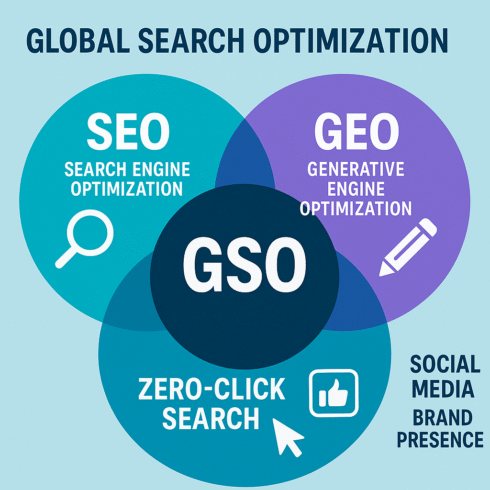
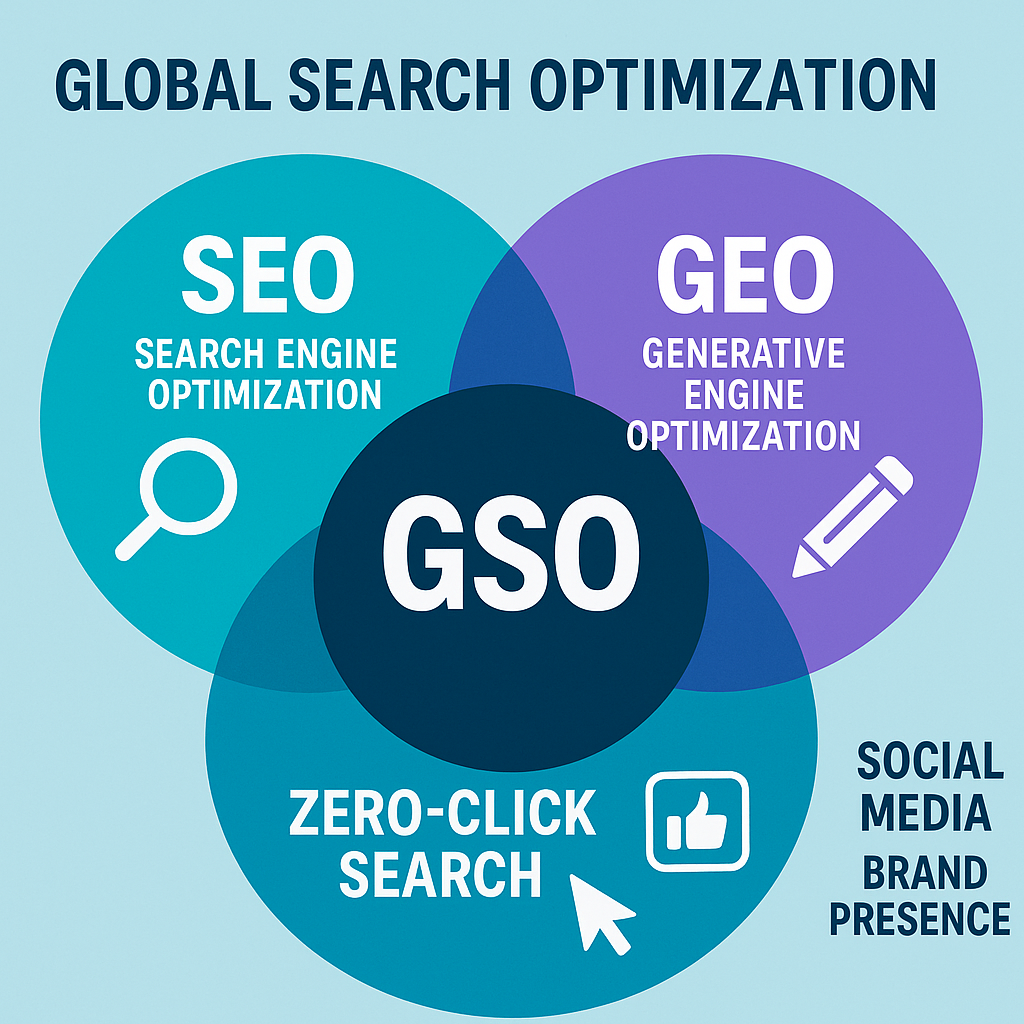
This connects to what we’ve long called digital PR: media mentions, editorial partnerships, content collaborations. Except today, those mentions don’t just feed your Google ranking, they also feed your visibility inside AI engines. Same logic of authority, two storefronts. Some are now calling this GSO, or Global Search Optimization: optimizing your content across every place travelers might find you, from your website and Google Business Profile to social media and AI models alike.
4. Trying to sell doesn’t work with AI
This one showed up in almost every GEO audit I ran.
AI models are information synthesizers. They look for reliable, instructive, unambiguous sources to build their answers. Meanwhile, a large share of travel and hospitality content is written to persuade, seduce, and push a booking. Fair enough, that’s marketing. “Experience the unforgettable.” “The best spot to…” “Don’t miss…”
The catch is that AI mostly ignores all of that. What it cites is content that directly answers a question: How do I visit this site in one day? What’s the best season to see this? What should I consider when choosing between these two options? Clear, structured text that delivers a real answer without trying to sell anything.
For several clients, this was a wake-up call. They had plenty of content, almost all of it built for conversion. No educational material, no real FAQ, few pages that actually answered the questions their future guests were asking.
That’s not a limitation. It’s an opportunity. The content that works best for AI is, more often than not, also the content that builds trust with a traveler who isn’t ready to book yet.
5. “AI” isn’t one channel. it’s five, maybe more
Last lesson, and it matters for anyone treating “optimizing for AI” as a single destination.
ChatGPT, Google Gemini, Perplexity, Google AI Overviews, Claude: each platform has its own architecture, its own data sources, its own way of weighing information. A brand can be highly visible on one and nearly absent on another, for reasons that have nothing to do with the overall quality of its digital work.
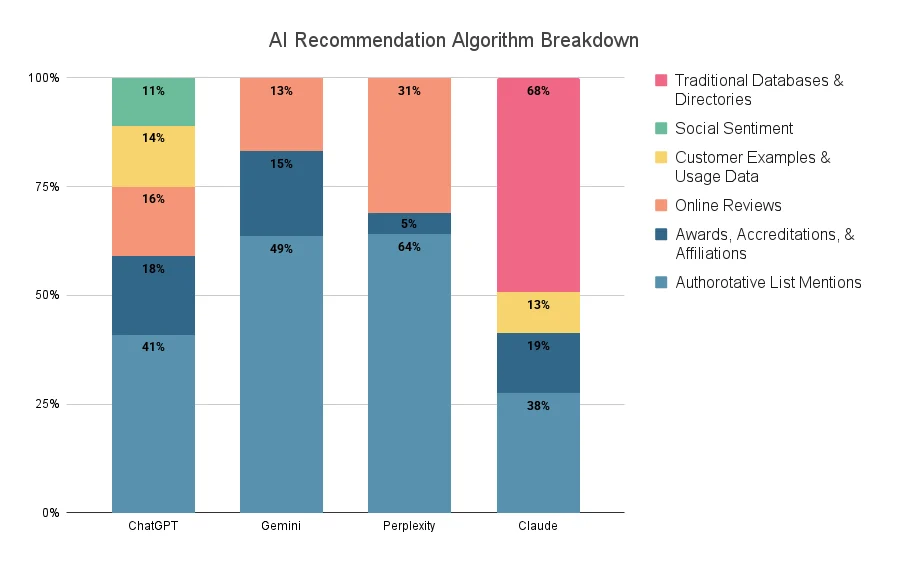
Across my audits, the gaps were often striking. One brand performed beautifully on Perplexity and was nearly invisible on Google AI Overviews. Another was well cited in ChatGPT but missing from Gemini. These aren’t random. They reflect real structural differences in how each tool indexes and ranks information.
It’s a bit like assuming that ranking well on Google automatically settles the score on Bing, LinkedIn, or YouTube. Each platform plays by its own rules. The good news is that the fundamentals help everywhere: quality content, domain authority, structured data. But understanding your strengths and gaps platform by platform is essential to knowing where to focus.
What this actually changes
These five lessons share one thread: you can’t optimize what you don’t measure. For years, existing tools let us gauge SEO performance with reasonable precision. Visibility inside AI engines remained a black box.
That’s no longer the case. Tools now exist to evaluate how a travel or hospitality brand shows up across the major AI platforms, based on different user profiles and search intents. That’s exactly what I ran for each of the clients mentioned in this article.
The process is a bit like an X-ray: it doesn’t fix anything on its own, but it shows you what’s actually happening before you decide what to do about it.
If you’re curious how your organization stacks up in this new landscape — SEO, GEO, or both — that’s now a core part of my audit mandates.









Leave a Reply