There is something oddly fascinating about watching Canada play on home soil while wondering, between scoring chances, what one of my clients could accomplish with that kind of advertising budget. Yes, I’m that kind of marketer. The one who can’t watch a Nike commercial without estimating the cost per impression, or spot a mascot without thinking about brand positioning. Watching our Reds take the field in Toronto and Vancouver, after a hard-fought 1-1 draw against Bosnia and Herzegovina followed by a commanding 6-0 victory over Qatar, makes it hard not to look beyond the excitement of the match and see the marketing lessons unfolding on the sidelines.
The 2026 FIFA World Cup, featuring 48 teams across three host countries, offers the perfect stage to observe marketing at its finest. Here are five takeaways that stood out to me, along with what they can mean for your own business and customers.
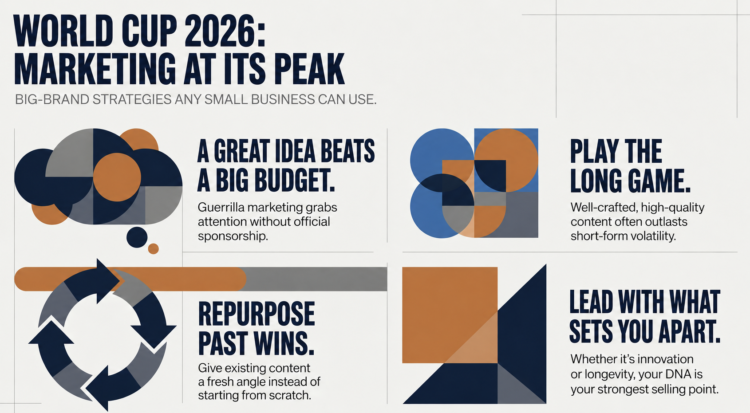
1. LEGO and the Art of Guerrilla Marketing
The smartest marketing move of this World Cup didn’t come from an official sponsor. LEGO doesn’t hold FIFA sponsorship rights. It only has a product licensing agreement. Yet the company managed to bring together Messi, Ronaldo, Mbappé and Vinícius Jr. in a campaign that generated enormous buzz without ever showing the tournament logo or mentioning FIFA.
This is ambush marketing at its most elegant. The brand capitalized on the excitement surrounding the event without paying for an official sponsorship.
For a hotel, inn or tourism business that can’t afford to sponsor a local festival, the lesson is clear. You don’t need to be an official partner to benefit from the attention an event creates. Sometimes, a stronger idea is worth more than a bigger budget.
2. Nike’s Bet on Long-Form Content
While many brands are satisfied with 20-second clips, Nike invested in a six-minute film valued at approximately US$2 million, making it the centerpiece of its global Rip the Script campaign.
Instead of interrupting viewers with another traditional commercial, Nike created something people actually wanted to watch.
The marketing lesson couldn’t be clearer. At a time when everyone is optimizing for 15-second Reels, there is still room for polished, long-form storytelling, provided the story is worth telling. A three-minute video about the history of a century-old business can easily outperform ten generic reels filled with beautiful sunsets.
3. Coca-Cola, Lamine Yamal and the Power of Reinvention
Rather than creating a brand-new anthem, Coca-Cola reimagined Van Halen’s Jump with J Balvin, Travis Barker and Steve Vai in a campaign featuring rising football star Lamine Yamal.
The brand didn’t reinvent the wheel. It gave a familiar classic new relevance for a younger audience.
That’s exactly how many tourism organizations should approach their existing content. That infographic gathering dust for two years, the customer testimonial buried in your archives, or the welcome message that has never been updated for AI-powered search can all be brought back to life with a fresh perspective instead of starting from scratch.
4. Hyundai and the Robots Everyone Is Talking About
Hyundai chose innovation as its playing field by featuring Boston Dynamics’ Atlas and Spot robots alongside Son Heung-min in a campaign that showcased the intersection of sports performance and technology.
It was bold, unexpected and memorable, attracting attention well beyond football fans.
Most businesses don’t have a humanoid robot at their disposal. What we do have is something unique that often goes unnoticed. It might be a chef who grows ingredients in an on-site garden, a concierge team that speaks six languages, or a ski package that includes an experience no competitor can offer. That’s your version of Atlas. The key is giving it the spotlight it deserves.
5. Budweiser and Loyalty as a Competitive Advantage
After forty years of World Cup involvement, Budweiser chose to celebrate its heritage rather than downplay it. The brand introduced packaging inspired by every tournament since 1986, accompanied by a film retracing its journey through some of the competition’s most iconic stadiums.
In a world obsessed with what’s new, celebrating longevity has become a powerful way to stand out.
For an inn celebrating its 30th anniversary or a festival marking its 25th edition, that history is a marketing asset in itself. You don’t always need to reinvent your brand. Sometimes the most compelling story is the one you’ve already lived.
Final Thoughts
When we look at the advertising surrounding this World Cup, we’re really watching companies tackle the same challenges we face every day, just with budgets that are thousands of times larger. The objective remains the same. Find the angle that resonates, choose the right format, repurpose content intelligently, dare to stand out, and embrace your story.
The ball may be rolling in Toronto, Vancouver, Boston or Mexico City, but these principles are just as relevant for a tourism business in the Eastern Townships, a local car dealership, or any company looking to earn the attention of its customers.
Meanwhile, our Reds continue their journey. We’ll keep one eye on the scoreboard and the other on the marketing opportunities that come with it.








Leave a Reply