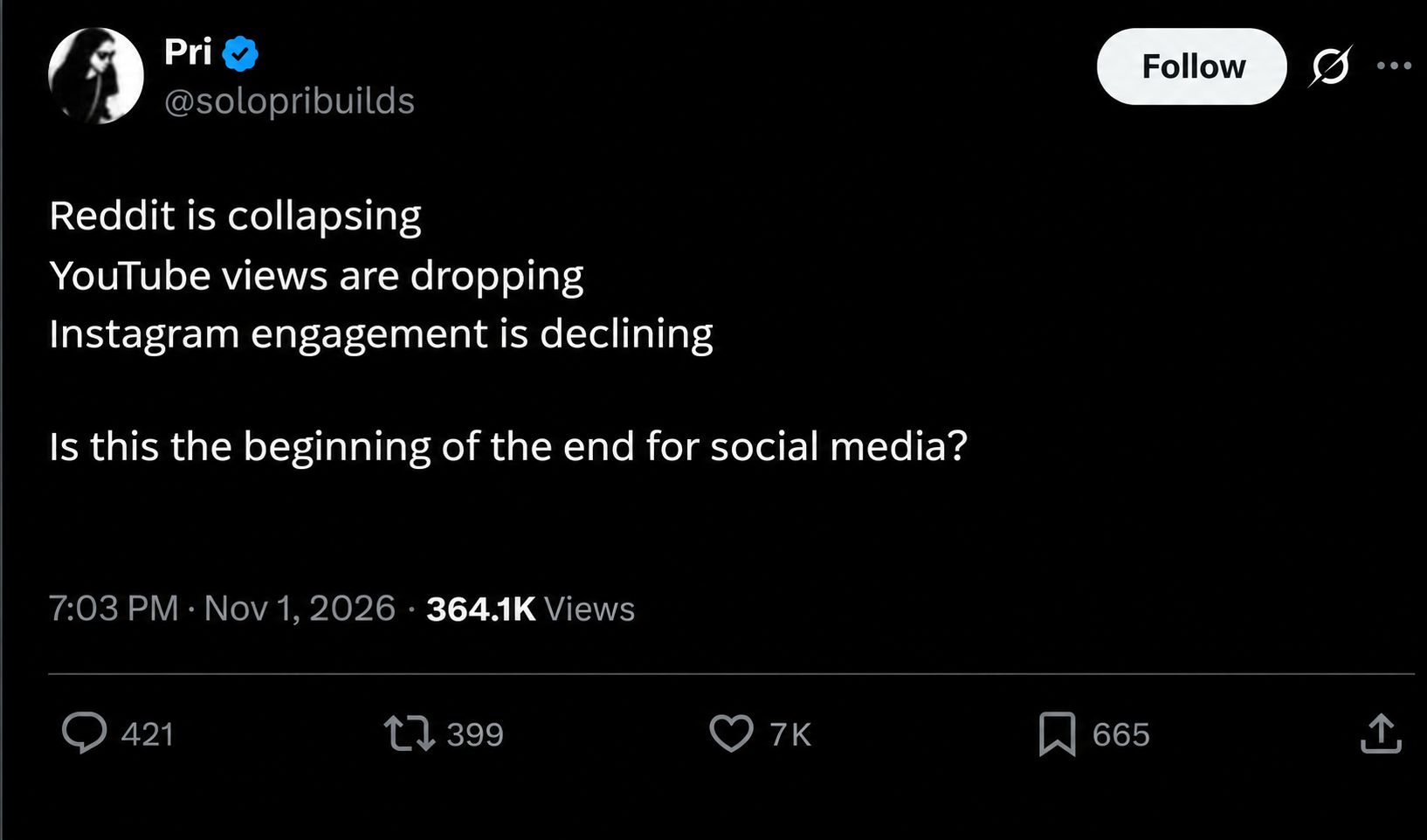
A post on X, viewed more than 364,000 times, sums up the mood: Reddit is collapsing, YouTube views are dropping, Instagram engagement is shrinking. Is this the beginning of the end? Not quite. People haven’t stopped talking. They’ve just left the town square for the group chat.
The decline is real, though, and it goes well beyond one viral post. Reddit lost 29% on the stock market on October 30. In the United States, its daily users fell from 53.2 to 50.7 million in a single quarter. Its CEO blames Google’s AI Overviews and AI Mode, which cost the platform more than a million visits a week in October. When the search engine answers the question itself, the click becomes optional.
The decline of Facebook is real
Facebook tells a similar story. In 2014, 71% of American teens used it. According to Pew Research, that figure is now 32%. What remains is a loyal base of fifty-somethings and a few neighborhood groups, which is respectable but hardly the future.
More telling are Meta’s own numbers, presented at the FTC trial: content posted by friends accounts for just 7% of time spent on Instagram and 17% on Facebook. These platforms have become television with a “share” button. Meanwhile, time spent on social networks peaked in 2022 and has since dropped 10% in developed countries, according to GWI for the Financial Times. The sharpest decline is among the heaviest users: teens and people in their twenties and thirties.
So where is everyone going? Three places, mostly.
- Private messaging. More photos and videos are now exchanged in direct messages than in Stories, and far more in Stories than in the feed. Telegram and similar apps are part of the picture too.
- Closed communities. Discord claims over 200 million monthly users, gathered in invite-only servers built around shared interests.
- AI assistants. ChatGPT sees roughly one billion weekly users. Nobody posts anything there. Everybody asks for everything.
The impact for travel marketers
For the hospitality and travel industry, this shift lands close to home. Think about how a trip actually gets planned. Someone sees a hotel, a ski resort or a restaurant on Instagram, and instead of liking it, sends it to a partner or a friend with a “this one?” That message is the new word of mouth, and it is invisible to every dashboard that only counts public reactions. It is also, quite possibly, the most valuable endorsement a property can receive.
Then there’s the discovery stage, which is migrating toward assistants. A traveler who asks an AI for a family-friendly inn near Quebec City or a boutique hotel in Lisbon never sees a feed. They see a short answer, with two or three names. If your property isn’t among them, no amount of beautifully lit breakfast photos will save you. That is the territory of generative engine optimization, and it deserves a spot on the marketing agenda right next to the content calendar.
Closed communities matter as well, especially for festivals, ski destinations, culinary scenes and loyal repeat guests. A well-run Discord server or private group won’t generate impressions by the millions, but it creates something rarer: people who show up, return and recommend.
KPIs need to adapt to the new reality
Brands, then, need a new yardstick. Likes still count, but sends and saves count more. Instagram and LinkedIn already display “sends” and saves, and that is no accident. The platforms know where the real value is shifting. For a hotel or a destination marketing organization, this means building content worth forwarding, a room, a view, a local tip, a deal that someone would actually pass along to a friend with a message like “we should go.”
People keep talking and exchanging, but less and less in public. For travel brands, that is one less weak signal to catch. In an industry built on trust and recommendations, learning to read the conversations you can’t see may be the most useful skill of the next few years.








Leave a Reply